Factory Specs & Quotes
Get unbranded (white-label) PDF datasheets and custom MOQ options directly from our engineering team. Fast 24-hour response. 100% Privacy Guaranteed. No spam.

Executive Summary: Solar PoE switches enable off-grid surveillance networks by integrating an intelligent 12V-to-56V DC voltage booster directly onto the industrial hardened mainboard, eliminating 30% power conversion losses from legacy inverters, and bridging long-distance gigabit fiber backhaul to 90W IEEE 802.3bt edge hardware in a unified, fanless enclosure.
Modern off-grid edge hardware—such as heavy-duty PTZ cameras, thermal imagers, and wireless APs—requires high-power IEEE 802.3bt Ultra PoE (up to 90W) at 54V–56V DC. However, standard solar arrays natively store and output only 12V or 24V DC.
Traditional setups bridge this gap using legacy AC inverters or external step-up regulators. This architecture introduces a severe 20% to 30% energy loss via heat dissipation, causing premature nighttime battery depletion. Furthermore, stuffing multiple separate components into a non-ventilated outdoor enclosure creates a thermal trap, accelerating hardware burnout and resulting in costly unexpected field maintenance.
To eradicate these points of failure, industrial networks are adopting a unified off-grid poe switch architecture. By integrating power regulation directly onto the hardened mainboard, the power distribution path is streamlined.
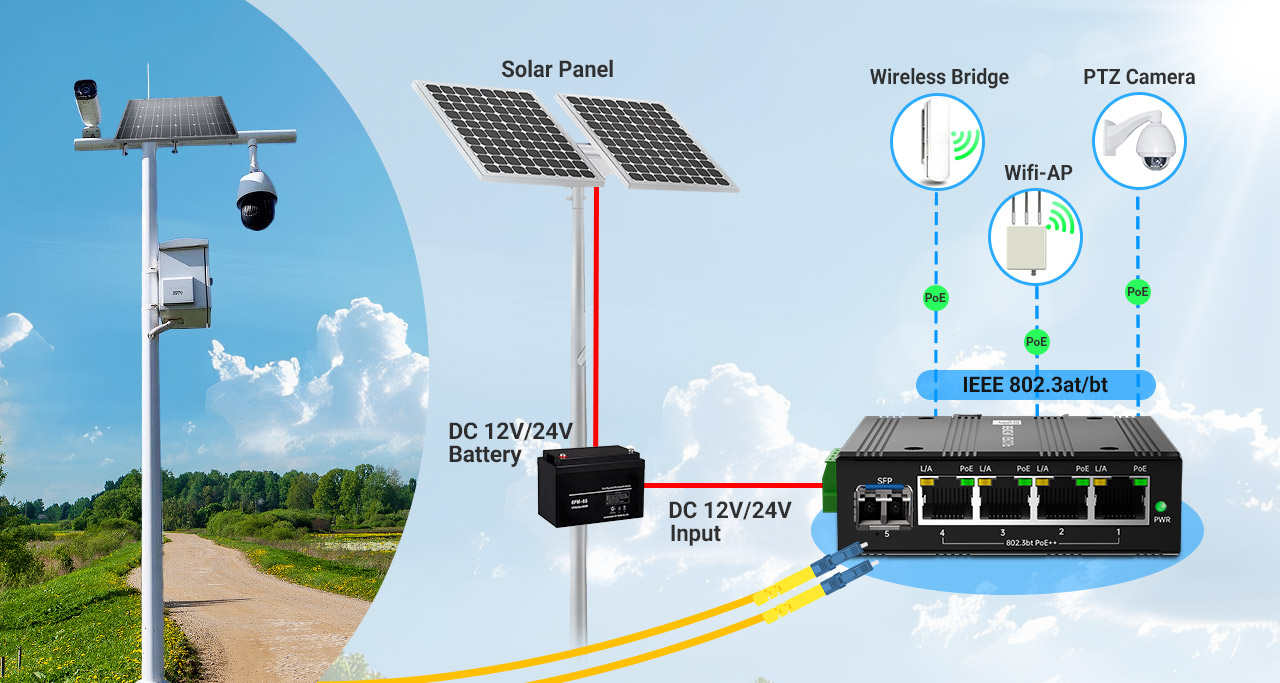
Instead of losing power across external converters, the integrated mainboard accepts 12V to 56V DC directly from the solar charge controller. It steps it up internally with over 95% efficiency, allowing systems to run longer on smaller battery arrays.
Equipped with next-generation IEEE 802.3bt Ultra PoE ports, the switch pumps out up to 90W per port. It easily handles power-hungry hardware during high-load operations, such as nighttime infrared (IR) activation.
Featuring a dedicated Gigabit SFP slot, it functions as a rugged industrial fiber to ethernet bridge. It links miles of remote optical fiber backhaul directly to localized copper edge devices without bandwidth drop.
Deploying a dedicated solar powered surveillance network delivers immediate operational value in high-cost environments:
| Industry Vertical | Specific Site Challenge | Engineering Solution |
|---|---|---|
| Remote Mining | Heavy airborne dust, constant mechanical vibration, and grid absence. | Fanless IP40 aluminum shell blocks particulates and tolerates extreme thermal shock (-40°C to 75°C). |
| Border Security | Long perimeters requiring optical fiber backhaul and high-wattage thermal imaging sensors. | Bridges long-distance fiber networks directly to 90W edge equipment via a localized solar pod. |
| Smart Agriculture | High humidity, open-field heat, and widespread IoT node power needs. | High-efficiency internal step-up booster prevents enclosure overheating, cutting out field maintenance. |
Eliminating legacy power hardware directly lowers your project's Total Cost of Ownership (TCO):
| • | Reduced Capital Expenditure (CapEx): High conversion efficiency allows engineers to safely specify smaller, lower-cost solar panels and battery banks per pole. |
| • | Minimized Enclosure Dimensions: Removing standalone converters frees up space, allowing the use of highly secure, compact, and cost-effective outdoor enclosures. |
| • | Zero Maintenance Truck Rolls: Hardened solid-state design eliminates moving parts, preventing unexpected system failures in remote locations. |
Don't guess your solar wattage or PoE budget. Share your device specifications, and our engineering team will provide a comprehensive system architecture design for your project.
Request a Free Custom Topology & Bulk Quote Envoyez-nous un email
 Appelez-nous
 Adresse
5F, Block5, GuangmingGu Industrial Park, Matian Villiage, Guangming Disitrict, Shenzhen, China



 Réseau IPv6 pris en charge
 Français