Factory Specs & Quotes
Get unbranded (white-label) PDF datasheets and custom MOQ options directly from our engineering team. Fast 24-hour response. 100% Privacy Guaranteed. No spam.

A TSN Ethernet switch is a network switch designed to support IEEE Time-Sensitive Networking functions for predictable, time-aware Ethernet communication.
The right choice depends on the application's timing requirements, connected devices, traffic characteristics, network architecture, and required TSN functions. Product specifications should be verified against the exact model and intended deployment rather than inferred from the term “TSN switch” alone.
Before selecting a TSN network switch, evaluate these five areas:
Start with the communication requirements of the application, not with a particular switch model. Identify which traffic must meet timing requirements, which devices need synchronized clocks, and whether scheduled transmission or redundant frame delivery is required.
Document the following before comparing products:
A typical connection layout for evaluating TSN switch integration in an industrial network.
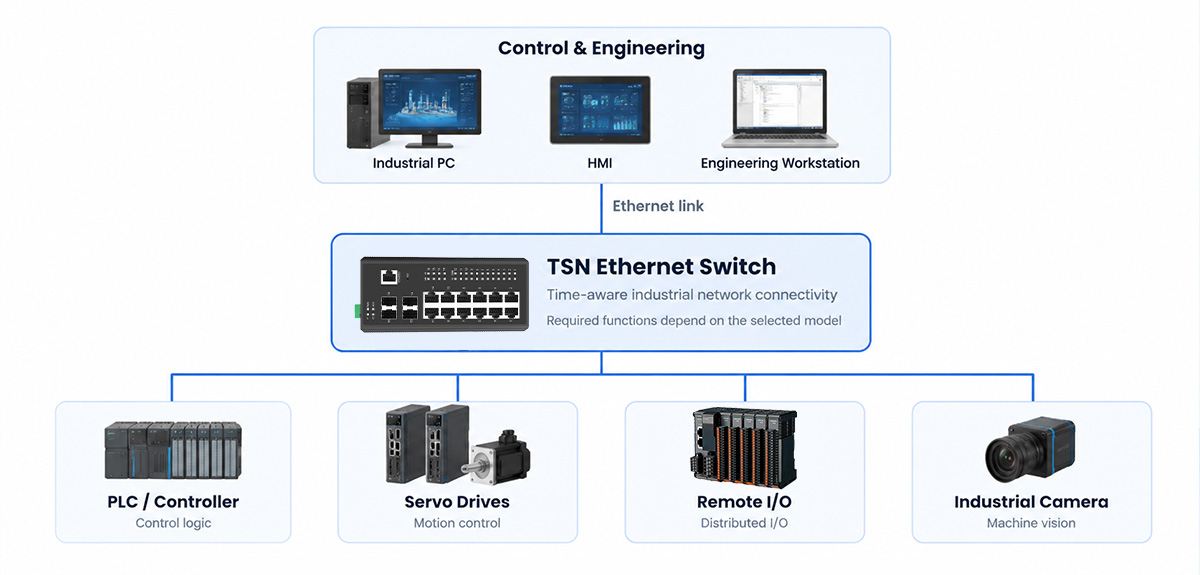
Illustrative architecture only. Actual connectivity, timing behavior, and supported TSN functions depend on the selected devices, network configuration, and application requirements.
TSN is a collection of IEEE 802.1 standards addressing different networking requirements, including time synchronization, scheduled traffic transmission, cyclic forwarding, and communication reliability.
When selecting a TSN network switch, verify the exact functions required by the application rather than assuming that every product supports the complete TSN feature set.
| IEEE Standard | Main Function | What Engineers Should Verify |
|---|---|---|
| IEEE 802.1AS / gPTP | Time synchronization | Confirm synchronization support and compatibility with connected devices. |
| IEEE 802.1Qbv | Time-Aware Scheduling | Verify support for scheduled traffic and the required configuration methods. |
| IEEE 802.1Qbu | Frame Preemption | Check whether frame preemption is required and supported across relevant devices. |
| IEEE 802.1Qch | Cyclic Queuing and Forwarding | Determine whether cyclic forwarding is needed for the application's communication requirements. |
| IEEE 802.1CB | Frame Replication and Elimination for Reliability | Confirm whether redundant frame transmission is required and supported by the selected product. |
The table summarizes the general purpose of these standards. It does not indicate that every TSN switch supports all of them.
After confirming the required TSN functions, check whether the hardware can accommodate the connected devices and expected traffic. Port count alone is not enough: interface type, uplink bandwidth, switching capacity, and forwarding performance all affect the suitability of a switch.
01 / INTERFACES
Match the number and speed of ports to controllers, industrial PCs, cameras, sensors, and other endpoints.
Check: Gigabit RJ45, fiber uplinks, connector types, and available expansion capacity.
02 / BANDWIDTH
Ensure the switching fabric can handle the expected aggregate traffic across access ports and uplinks.
Check: Switching capacity, uplink oversubscription, and expected traffic load.
03 / PROCESSING
Check whether the switch can process the expected packet rate while meeting the application's traffic requirements.
Check: Forwarding rate, traffic mix, packet sizes, and relevant test conditions.
For industrial deployments, also consider environmental and operational requirements, including operating temperature, power redundancy, mounting method, surge protection, and network management capabilities.
A TSN switch must work with the surrounding network, not just meet a specification on paper. Follow these five steps to validate compatibility before committing to a large deployment.
For OEMs, system integrators, distributors, and industrial networking brands, supplier evaluation should cover technical transparency, integration support, product lifecycle, and project requirements. Use the following checklist when comparing potential suppliers.
01
Check whether the supplier provides clear, model-specific technical information.
Ask: Which TSN functions are implemented on the exact model being quoted?
02
Determine whether the supplier can help assess interoperability and troubleshoot integration issues.
Ask: What test evidence and integration assistance are available?
03
For long-term projects, confirm how the supplier handles product changes and ongoing support.
Ask: Which customization and lifecycle support options can be confirmed?
04
Confirm whether the supplier can meet purchasing, delivery, and ongoing project requirements.
Ask: Can the supplier support the project schedule and future orders?
Compare suppliers against the same technical, integration, lifecycle, and commercial requirements. Prioritize documented capabilities and relevant test evidence over broad claims of complete TSN compatibility.
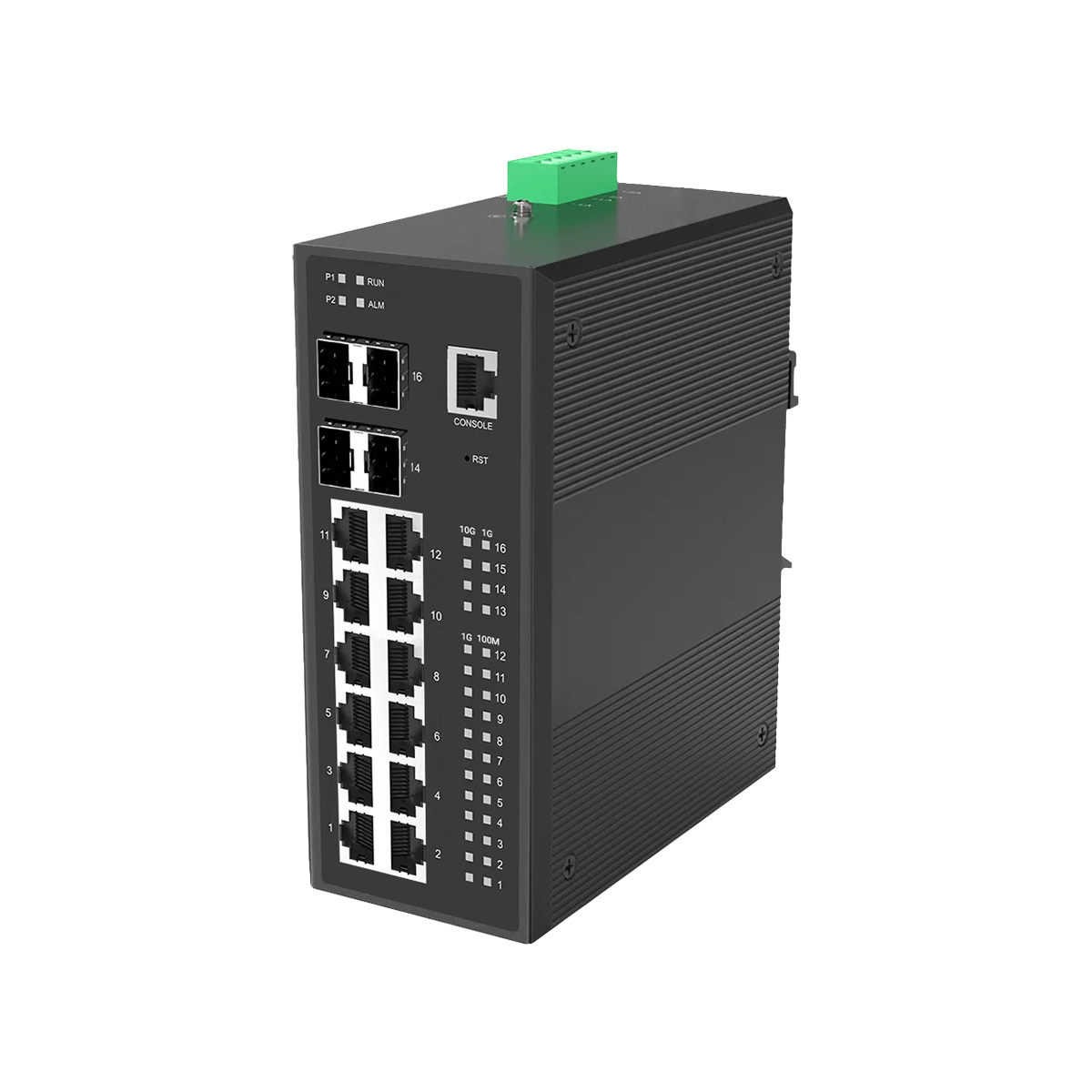
For projects requiring Gigabit access ports and high-speed uplinks, the BENCHU TSNS7500-12GE4TF-L3M is a Layer 3 TSN switch option to evaluate against the network's interface, capacity, and required TSN functions.
Product selection note: The specifications above identify the listed product configuration. Confirm the current datasheet, supported functions, and application-specific requirements with BENCHU before finalizing a design.
Start by identifying the required TSN functions, synchronization requirements, traffic profile, and timing targets. Then compare port configuration, uplink speeds, switching capacity, forwarding performance, and the supplier's model-specific documentation. The final choice should match the application's technical requirements rather than the product label alone.
Request the exact model's datasheet and technical documentation. Check each required standard, supported operating modes, configuration dependencies, and any limitations. If a function is critical to the application, ask the supplier for relevant test evidence instead of relying solely on a general TSN compatibility claim.
Identify the controllers, endpoints, other switches, and configuration tools in the network. Confirm that the required synchronization and traffic-management functions are supported across the relevant devices. Where timing is critical, validate the complete configuration under representative traffic and record the test conditions and results.
Provide the required TSN standards and functions, number and types of ports, uplink speeds, connected devices, environmental conditions, management requirements, and expected order quantity. For OEM/ODM or private-label projects, also specify branding, customization, documentation, delivery, and support requirements. This information helps the supplier assess product suitability and prepare a more relevant proposal.
Selecting a suitable TSN switch requires matching supported functions, hardware specifications, and integration requirements with the intended application.
BENCHU offers TSN Ethernet switch solutions for industrial networking projects, with product configurations and OEM/ODM options available for evaluation according to project requirements.
Contact BENCHU to discuss:
Share your application, interface requirements, and required TSN functions with our team to discuss the next steps for technical evaluation.
Contact BENCHU for TSN Switch Details Envoyez-nous un email
 Appelez-nous
 Adresse
5F, Block5, GuangmingGu Industrial Park, Matian Villiage, Guangming Disitrict, Shenzhen, China



 Réseau IPv6 pris en charge
 Français