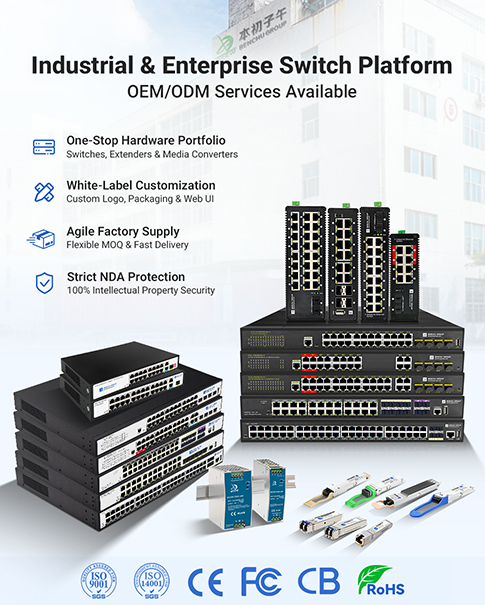
Factory Specs & Quotes
Get unbranded (white-label) PDF datasheets and custom MOQ options directly from our engineering team. Fast 24-hour response. 100% Privacy Guaranteed. No spam.

Modern industrial field devices—such as pan-tilt-zoom (PTZ) cameras with built-in heaters, Wi-Fi 7 access points, and localized AI computing nodes—have outgrown standard PoE capabilities. While legacy IEEE 802.3af (PoE) and 802.3at (PoE+) cap out at 15.4W and 30W, The IEEE 802.3bt PoE++ standard, implemented through managed industrial PoE++ switches, delivers up to 90W per port. By leveraging all four pairs of copper cabling, 90W PoE++ ensures up to 71.3W of guaranteed power at 100 meters while cutting cable line loss in half.
Power over Ethernet has undergone three major evolutionary steps to keep pace with bandwidth and power demands at the network edge. Understanding these differences is critical when selecting network switches for industrial deployments.
| Specification | PoE (IEEE 802.3af) | PoE+ (IEEE 802.3at) | PoE++ (IEEE 802.3bt) |
|---|---|---|---|
| Standard Year | 2003 | 2009 | 2018 |
| Conductor Utilization | 2 Pairs (4 conductors) | 2 Pairs (4 conductors) | 4 Pairs (8 conductors) |
| Max Output Power at PSE | 15.4W | 30.0W | 60W (Type 3) / 90W (Type 4) |
| Guaranteed Power at PD (100m) | 12.95W | 25.5W | 51.0W (Type 3) / 71.3W (Type 4) |
| Cable Requirement | Cat3 or better | Cat5e or better | Cat6 / Cat6A (Recommended) |
| Primary Target Devices | Basic IP Phones, Static Cameras | Fixed HD Cameras, Basic APs | PTZ Cameras, Edge AI, Wi-Fi 7 |
Why is transmitting power over four pairs better than over two pairs? The key lies in basic electrical physics. When current flows through copper conductors, energy is lost as heat according to Joule's Law (P = I²R).
By distributing electrical current across all 4 twisted pairs (8 conductors) rather than 2 pairs (4 conductors), the current per conductor is halved. Because power dissipation scales quadratically with current, halving the current reduces thermal power loss by up to 50% along the 100-meter cable run.
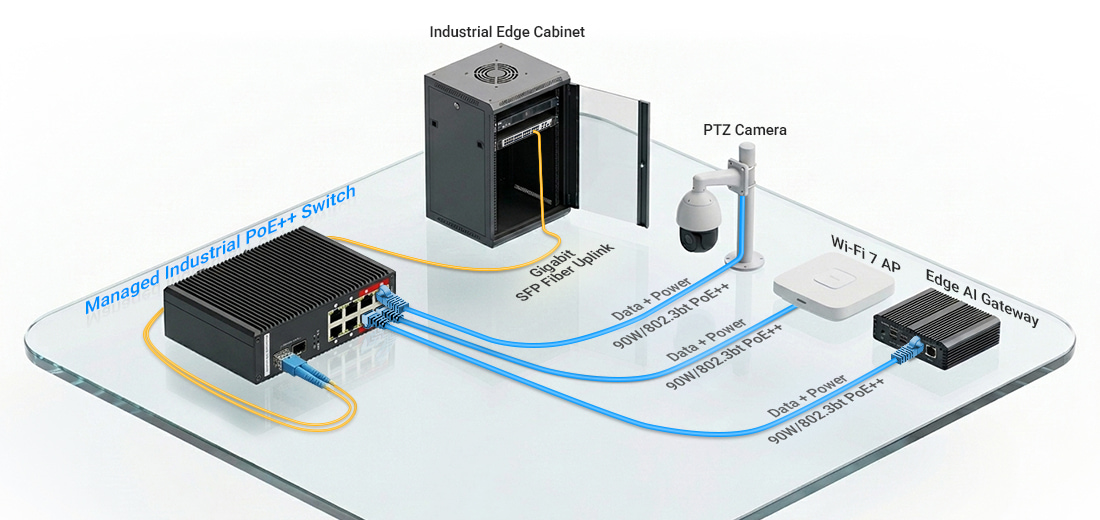
Upgrading to 90W power delivery is no longer optional for high-load edge deployments. Modern industrial devices require a dedicated high-wattage power budget to run reliably:
Deploying high-wattage power in harsh factory environments requires more than just raw power. Managed industrial PoE++ switches combine robust physical enclosures with automated management tools like Ping Watchdog to monitor connected endpoints continuously and automatically power-cycle frozen devices.
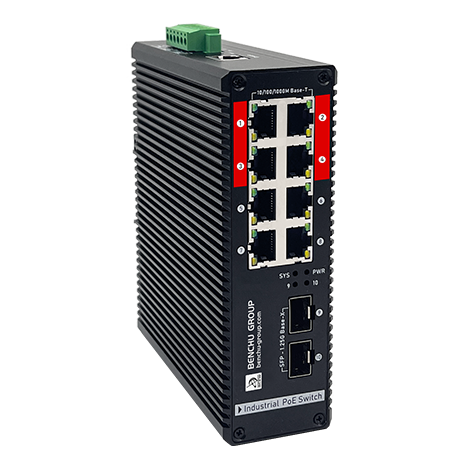
Model: IES7511-8PGE2GF-4BT-DC
Migrating from legacy PoE and PoE+ to IEEE 802.3bt PoE++ infrastructure enables higher-power, more efficient, and more scalable industrial edge deployments through three key advantages:
As a trusted manufacturing partner for global telecom and security brand owners, we deliver high-power 90W PoE++ solutions tailored to your exact specifications. From specialized hardware customization to full lifecycle engineering support, our team ensures your industrial network portfolio remains reliable, compliant, and competitive.
Explore OEM/ODM Solutions & Request a Partner Quote → Envoyez-nous un email
 Appelez-nous
 Adresse
5F, Block5, GuangmingGu Industrial Park, Matian Villiage, Guangming Disitrict, Shenzhen, China



 Réseau IPv6 pris en charge
 Français